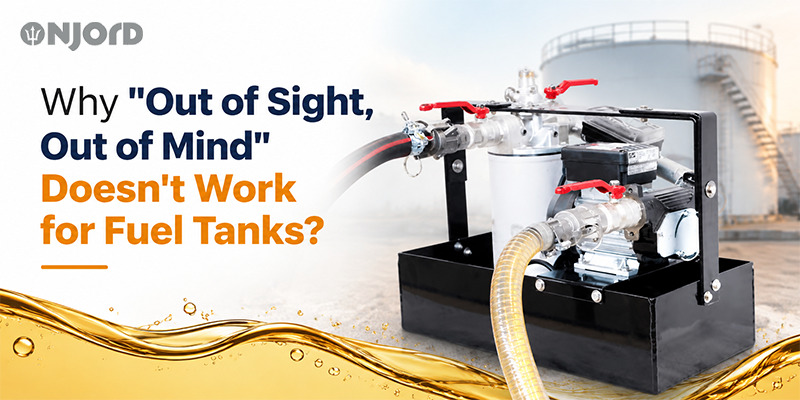
Once fuel tanks are filled and out of sight, they are often easy to forget about. That is a dangerous assumption. Problems can happen quietly inside the tank. Water, dirt and rust can build up. The fuel can feed the growth of tiny microorganisms.
You can't see these problems from the outside. Nor does anything of this sort vanish just because it is ignored. Usually, a fuel tank doesn't send out an external signal to get attention, such as a dashboard light on a car.
Often, by the time an issue is detected, it is too late. The danger of ignoring a fuel tank is that the problems will fester unnoticed. Hence, you can either go for proactive diesel management or you can also avail the containerized filtration system as well, only from Njord Filtration.
Table of Contents
- What are the first warning signs that a "forgotten" fuel tank has degraded?
- How quickly can diesel go bad in a tank that's never been checked?
- What is the difference between fuel polishing and simple filtration when addressing neglected tanks?
- How often do manufacturers recommend recirculating or testing stored diesel?
What are the first warning signs that a "forgotten" fuel tank has degraded?
- The engine is difficult to start
If your engine is hard to start, stalls or shudders, it means your fuel is old. Your engine is not performing well because of dirty or old fuel. - Appears Dark in Color
Good diesel fuel should be clear. If you take a sample of the fuel and it looks cloudy, dark or dirty, it means that you have water or germs inside it. - Sludge in Fuel Tank
Any external particles can cause sludge to build up in the fuel tanks. The old one can be the cause of this type of sludge, especially if it is stored for a long time. - Regular Filter Blockage
If you have to change or clean your fuel filter regularly, this is a sign that you have small particles in it - Offensive Smell
If your diesel smells like something is wrong, such as sour or rotten, then it means there are bacteria or molds in your storage tank.
How quickly can diesel go bad in a tank that's never been checked?
Diesel doesn't have a "best before" date because it tends to go off a lot quicker than one might think. Diesel fuel stored in a sealed tank at a constant temperature will last anywhere from 6 to 12 months.
However, if the tank condition is not tested, the spoiling can happen much faster. Moisture can be drawn into the tank through the tank breather.
Adding water to the tank allows bacteria and fungi to grow within weeks, resulting in clogged filters and sludge production. Fuel deterioration occurs after three to six months. The portable mobile tank cleaning systems can not only clean the diesel, but also can be moved to anywhere as per the requirement.
What is the difference between fuel polishing and simple filtration when addressing neglected tanks?
|
Aspects |
Fuel Polishing |
Standard Filtration |
|
Coverage |
Cleans the entire tank, including the fuel which is not in use. |
Only cleans the fuel while it flows into the engine. |
|
Water removal |
This process actively removes through coalescing filters. |
It catches the minimal particles of the water. |
|
Sludge and sediment |
It breaks down the sludge and sediments and removes them. |
It cannot remove the existing sludge but can block the new particles. |
|
Microbial contamination |
Removing the water prevents microbial and fungal growth. |
It does not reduce the fungal growth that is already present in the tank. |
|
Types of processes |
The fuel passes through multiple filters until it becomes properly clean. |
Here, it passes through only once while the engine is running. |
|
Best use cases |
Neglected oil, stored for a long time or hidden fuel contamination . |
Storage tanks with fuel that is almost clean. |
How often do manufacturers recommend recirculating or testing stored diesel?
Most engine and fuel suppliers recommend testing fuel every 3 to 6 months. Even if the machine is not used on a regular basis, it is necessary to fully cycle the fuel (fuel polishing) one or two times a year.
For critical backup equipment such as emergency generator systems and fire pumps, fuel testing and polishing are done more often, at least every three months. Failures of this type of equipment will result in losses.
It should be below 70 ppm of water content and meet the ISO 4406:1999 fuel contamination standard. Most of the engine manufacturers define these standards. Fuel tanks that experience large temperature swings, high humidity and biofuel blends need to be inspected and tested more often.
What You Should Do Next
A fuel tank that is never checked will not be considered safe just because it cannot be seen into. Over time, dirt, water and bacteria can accumulate. This can cause damage to your engine and incur costs.
Checking and cleaning the fuel regularly will prevent such issues. Don't wait until it breaks. Contact Njord Filtration today for testing or a cleaning service that can enhance the backup generator fuel reliability.
FAQs
- How do you know if your fuel tank needs to be tested or cleaned?
If your engine is hard to start or it is running poorly, then there is a good chance that your tank needs to be checked out. Frequent clogging of your fuel filters is also a sign of the same. - Is fuel polishing the same as a fuel filter?
No. Fuel polishing cleans the fuel along with water and sediments that have settled at the bottom of the tank, whereas the fuel filter cleans the fuel as it passes to the engine. - Can I clean the fuel without opening the storage tank?
Yes, you can clean the fuel through the polishing system properly without opening the tank.