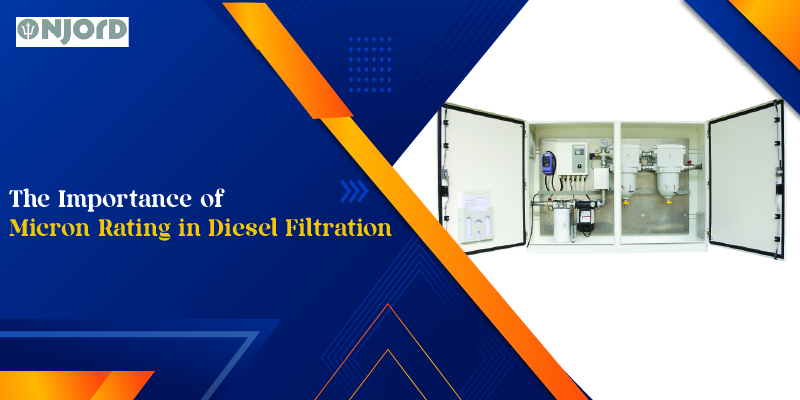
You already know that in diesel-powered systems, clean fuels play a significant role not only for the engine health, but also for uninterrupted operations. However, the level of purification of the diesel plays a substantial role in its performance. Well, that's where the micron rating of the diesel filtration system comes in. If you're unsure what a micron rating is and how it works in diesel fuel, this blog is for you.
Here, Njord Filtration will explain the different types of micron ratings, where they matter the most, and everything else you should know about them. So, keep reading to learn more.
But first…
Micron Rating in Diesel
Simply put, a micron, or micrometre, is a unit of measurement which is one-millionth of a meter, which is around 0.001 millimeters. For example, fine beach sand is of 90 microns while bacteria are of 0.5–5 microns. Similarly, diesel fuel flows through a filter designed to catch contaminants at 2, 10, or even 30 microns.
But why does that even matter?
Well, the answer is simple. Micron rating directly affects what kind of contaminants a filter can trap. In diesel fuel, the primary problems include water droplets, dirt or dust, metal shavings, rust particles, microbial sludge, and other fuel degradation byproducts. These particles can enter the fuel system, clog injectors, damage fuel pumps, and cause poor combustion, ultimately leading to complete engine failure.
(Also read from previous blogs: Preventing Diesel Engine Damage on Your Yacht with Advanced Filtration Systems )
However, it is also essential to know that two variants of microns play a significant role in diesel filtration, namely Absolute Micron and Nominal Micron.
Which industries should use Micron Ratings?
The following industries need a diesel filtration micron rating:
- Hospitals & Healthcare
In hospitals, the backup generators need clean fuel. For that, they use 5-micron or lower filters to prevent any failure. - Marine & Offshore Vessels
In the marine and offshore industries, the fuel quality degrades during long voyages. In such cases, filters with a size range of approximately 10 to 2 microns can protect the injector from damage during mid-sea operations. - Industrial Machinery
Next, in industrial machinery, heavy dust and moisture exposure can ruin the fuel quality. In that case, start with 30-micron pre-filters, followed by 5–10 micron final filters. - Fuel Storage Systems
Now, in fuel storage systems, sludge and microbial growth start to grow rapidly. For that, a mix of coarse and fine micron filters is best.
Nominal Micron Rating:
Nominal Micron ratings remove around 50–90% of particles of the stated size. For example, a 10-micron nominal filter will trap about 50–90% of all particles that are 10 microns in size. These are good for non-critical applications.
Absolute Micron Rating:
On the other hand, the Absolute Micron Rating removes 98.7% or more of the stated particle size, like a 5-micron absolute filter, which will capture nearly all particles that are 5 microns or larger. These are good for critical machines like marine engines, hospitals and airports.
How to Test If Your Micron Rating Is Working
Here's how to test diesel fuel cleanliness:
- Fuel Sampling
First, you need to take samples from your tank's top, middle and bottom layers and send them for lab testing. - Particle Count Analysis (ISO 4406)
The labs will then tell you how many particles per millilitre your fuel has at specific micron sizes. - Water Content Analysis
Since water in diesel is as problematic as solids, filters with good micron ratings should be paired with water separators.
Micron Ratings and Filter Maintenance
Choosing a finer micron filter, like 2 microns, will give you cleaner fuel. But it will also clog faster. To address this issue, you can utilize staged filtration, monitor pressure differentials across filters, and clean or replace them according to usage or maintenance intervals. But remember, balance is key because if it's too fine, it will clog. If it's too coarse, it won't filter well.
Bottom Line
Electricity is essential, whether in critical areas or non-critical areas. This is why it is vital to ensure that the micron sizes in the diesel filtration system are well balanced. As we mentioned earlier, the filtration result largely depends on the micron sizes. Therefore, for problem-free services, investing in a Njord diesel filtration system is essential.
Make the booking now by getting in touch with us. Contact here .